Text or WhatsApp (808) 600-9260

Capital gains tax charts and infographics

Charts and flowcharts that show how the rules work. Each one has a written caption with the same facts, plus the source it comes from.

Gain and loss netting chart

Enter your gains and losses to see them netted. The default figures are the IRS example from Publication 550: a $7,000 capital loss with no other capital transactions, $3,000 deducted on the 2025 joint return, and $4,000 carried over to 2026 [CGT2-0180, tax year 2025]. The $3,000 figure applies to a joint return in the IRS example.

Sources for every figure

As of October 20, 2026, based on Publication 550 (2025), Investment Income and Expenses, our research shows this may be the case. The law changes, so this could be outdated or wrong. Confirm with a licensed tax attorney or CPA before acting. This page is general education, not tax or legal advice for your situation.

2025 long-term capital gain rate brackets by taxable income

Each bar shows taxable income ranges where "other" long-term gain is taxed at 0%, 15% or 20% in 2025 [CGT2-0180, tax year 2025]. Bars are drawn to scale up to $700,000.

Single$48,350$533,400Married filing jointly$96,700$600,050Head of household$64,750$566,700Married filing separately$48,350$300,0000%15%20%

Sources for every figure

As of October 20, 2026, based on Publication 550 (2025), Investment Income and Expenses, our research shows this may be the case. The law changes, so this could be outdated or wrong. Confirm with a licensed tax attorney or CPA before acting. This page is general education, not tax or legal advice for your situation.

Short term or long term?
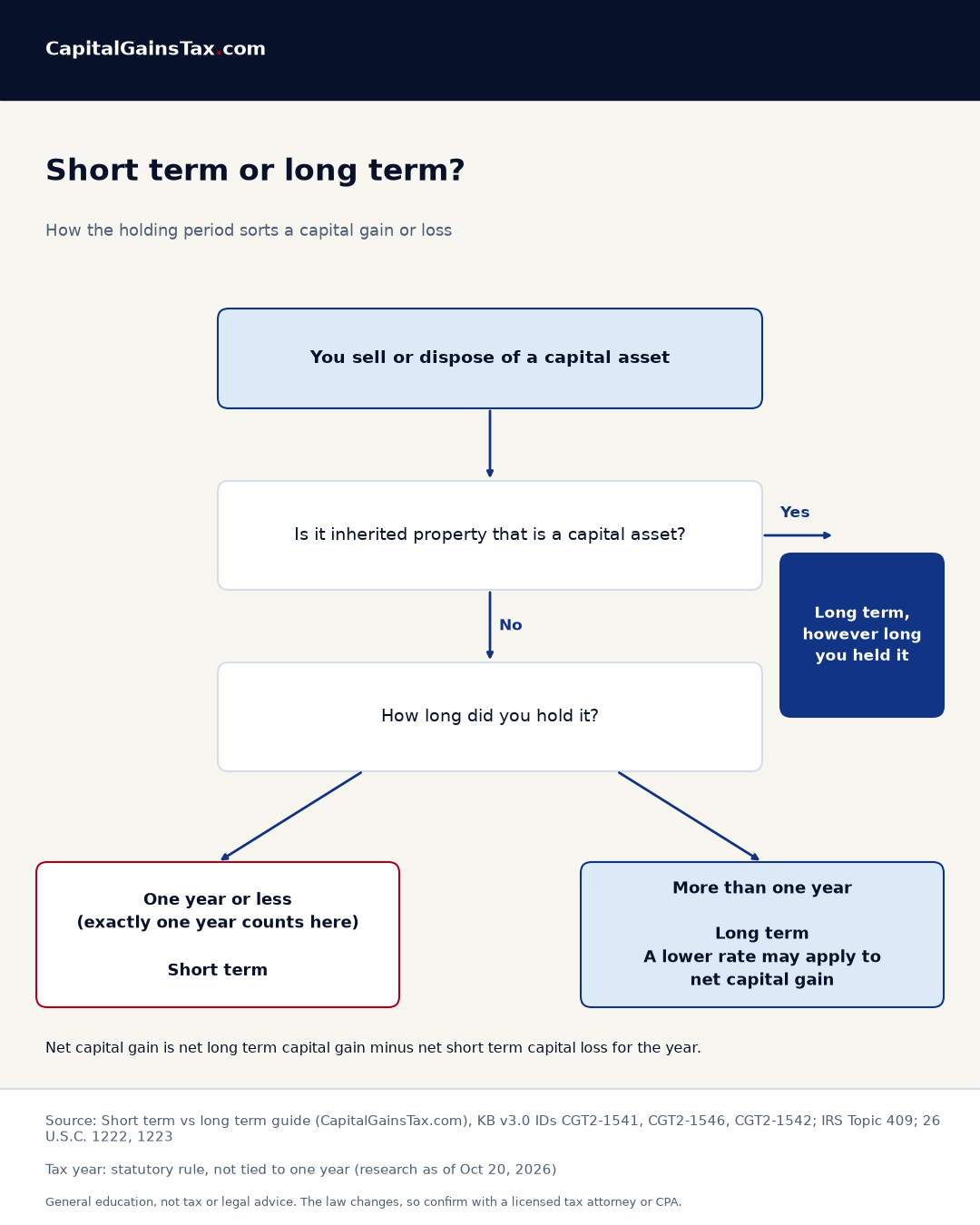
Flowchart: inherited capital assets are long term; others are long term if held more than one year, short term if one year or less
How the holding period sorts a capital gain or loss. When you sell or dispose of a capital asset, first ask whether it is inherited property that is a capital asset. If yes, it is long term, however long you held it. If no, look at how long you held it. One year or less (exactly one year counts here) is short term. More than one year is long term, and a lower rate may apply to net capital gain. Net capital gain is net long term capital gain minus net short term capital loss for the year.Source: Short term vs long term guide; IRS Topic 409; 26 U.S.C. 1222, 1223. Statutory rule, not tied to one year. Read the full guide: Short term vs long term capital gains and the holding period.

The 1031 exchange clock

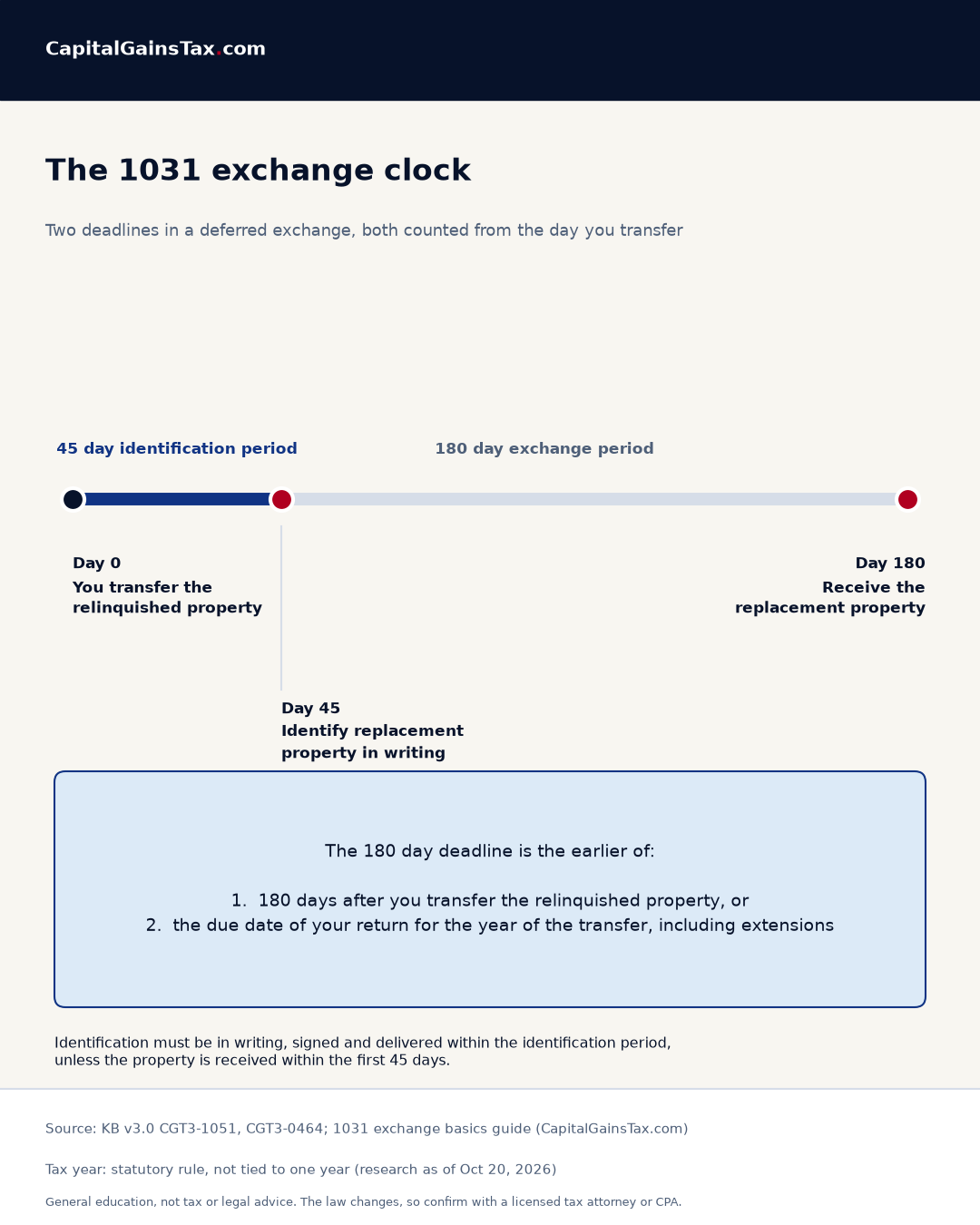
Timeline of a deferred 1031 exchange: transfer on day 0, identify replacement property by day 45, receive it by day 180
Two deadlines in a deferred exchange, both counted from the day you transfer. Day 0: you transfer the relinquished property. Day 45: identify replacement property in writing. Day 180: receive the replacement property. The 180 day deadline is the earlier of 180 days after you transfer the relinquished property, or the due date of your return for the year of the transfer, including extensions. Identification must be in writing, signed and delivered within the identification period, unless the property is received within the first 45 days.Source: 1031 exchange basics guide; 26 U.S.C. 1031. Statutory rule, not tied to one year. Read the full guide: Like kind exchanges under Section 1031.

The home sale exclusion, step by step
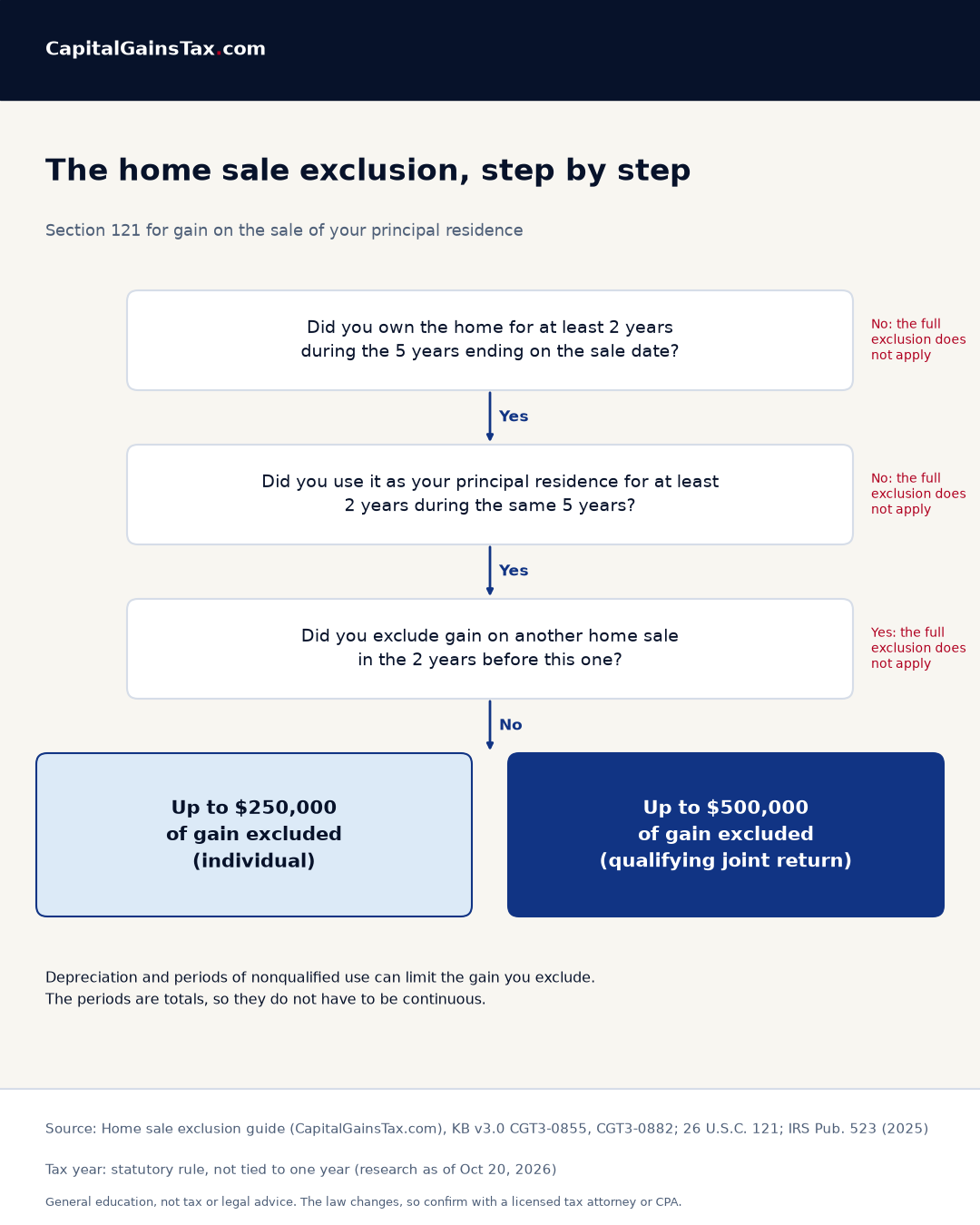
Flowchart of the Section 121 tests, leading to up to $250,000 of gain excluded, or $500,000 on a qualifying joint return
Section 121 for gain on the sale of your principal residence. Did you own the home for at least 2 years during the 5 years ending on the sale date? Did you use it as your principal residence for at least 2 years during the same 5 years? Did you exclude gain on another home sale in the 2 years before this one? If you answer yes, yes and no, up to $250,000 of gain is excluded (individual), or up to $500,000 (qualifying joint return). If any answer goes the other way, the full exclusion does not apply. Depreciation and periods of nonqualified use can limit the gain you exclude. The periods are totals, so they do not have to be continuous.Source: Home sale exclusion guide; 26 U.S.C. 121; IRS Pub. 523 (2025). Statutory rule, not tied to one year. Read the full guide: The home sale exclusion under Section 121.
Richard C. Wilson, founder of Family Office Club
Questions about a sale

Talk to Richard

Richard C. Wilson, founder of Family Office Club