
You generally recognize no gain or loss when you exchange real property held for business or investment solely for real property of like kind that you will also hold for business or investment. You must meet the identification and receipt deadlines, and receiving money or other property can result in recognized gain.
What your exchange must qualify for
Section 1031 provides nonrecognition of gain or loss when you exchange qualifying real property solely for qualifying real property of like kind. You must hold the property you transfer for productive use in a trade or business or for investment. You must plan to retain the acquired real estate for productive business use or investment.
Your purpose for holding both properties matters. The business or investment requirement applies to the real property you give up and the real property you receive. An exchange of real property may qualify as a nontaxable exchange under Section 1031 when you satisfy those requirements.
If you also receive money or property that is not of like kind, your exchange has a different recognition result. Generally, you recognize gain to the extent of that money and other property received. You do not recognize a loss under that rule.
What counts as real property
For your Section 1031 exchange, the regulatory definition of real property includes land and improvements to land. It also includes unsevered natural products of the land, along with water and air space above land. The definition further describes tangible and intangible real property.
The regulations limiting Section 1031 to exchanges of real property apply to exchanges beginning after December 2, 2020. They define real property for Section 1031 and address your receipt of personal property that is incidental to the real property you receive in an exchange.
How your properties can be of like kind
Your properties are of like kind if they have the same nature or character. They can differ in grade or quality. Generally, real properties are of like kind regardless of whether they are improved or unimproved.
Your property can fall under one definition of real property in the final regulations, while the property you receive falls under another definition. That difference does not by itself prevent the properties from being of like kind. Real property classified under one definition may be of like kind to real property classified under another.
Location creates a separate limit for your exchange. Real property located in the United States and real property located outside the United States are not of like kind. The general treatment of improved and unimproved real estate does not remove that geographic limit.
Property excluded from your Section 1031 exchange
You cannot apply Section 1031 to an exchange of real property you hold primarily for sale. The statute expressly excludes that property from the subsection providing nonrecognition for qualifying exchanges.
Section 1031 also excludes certain exchanges involving tax exempt use property subject to a lease under Section 470(e)(4). Your property being real estate does not remove this exclusion or the exclusion for real property held primarily for sale.
Your identification and receipt deadlines
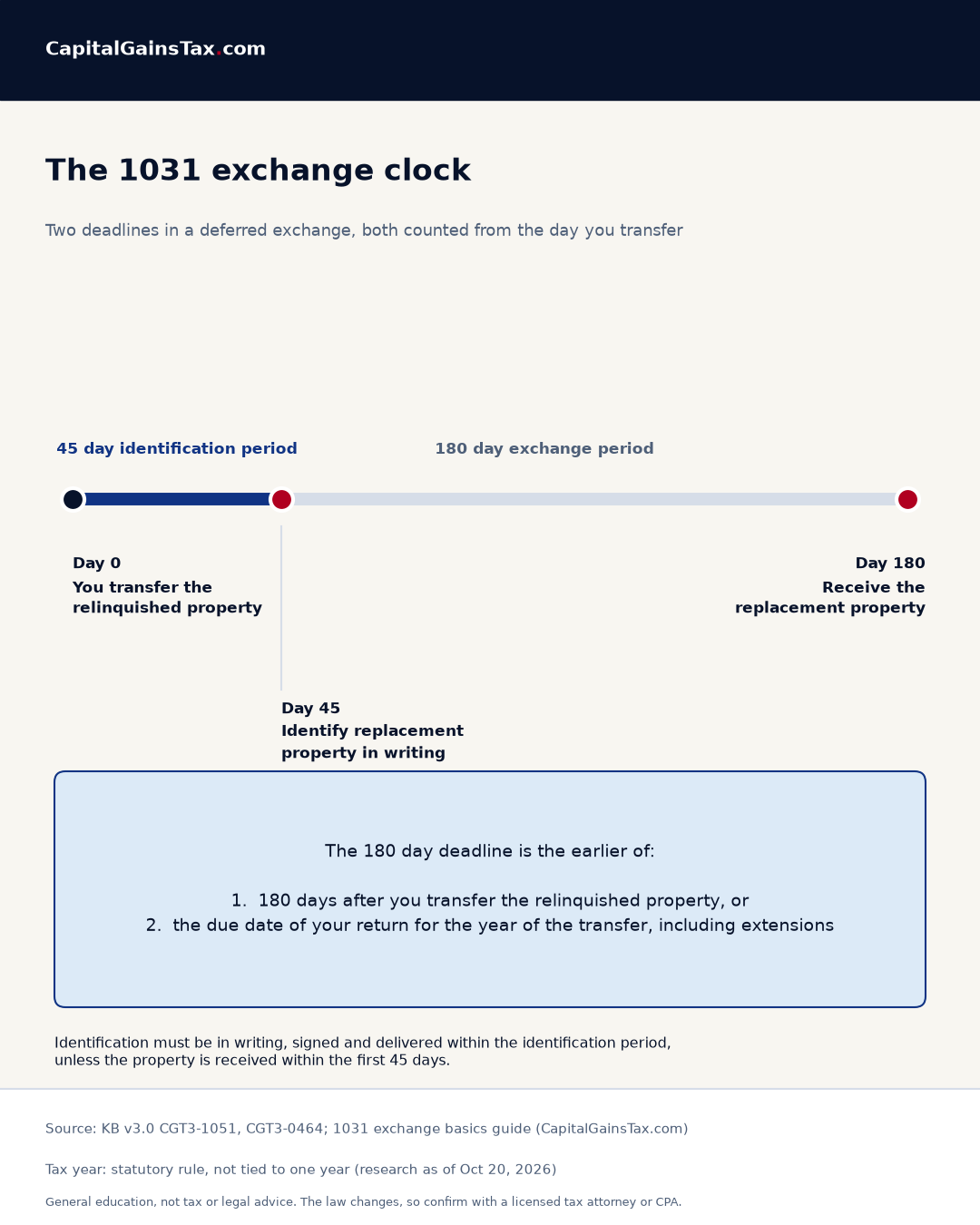
Under Section 1031(a)(3), you must identify replacement property within 45 days after you transfer the property you give up, and receive it by the earlier of 180 days after that transfer or the due date of your tax return for the year of the transfer, including extensions. You can identify up to three replacement properties without regard to their fair market values, or any number of properties as long as their total fair market value at the end of the identification period is not more than 200 percent of the total fair market value of all the properties you gave up as of the dates you transferred them. If, at the end of the identification period, you have identified more properties than that, you are treated as if you identified no replacement property, except for any replacement property you receive before the 45-day identification period ends, and any property you identify before that period ends and receive before the exchange period ends, but only if the identified property you receive before the exchange period ends is worth at least 95 percent of the total fair market value of all the properties you identified. For this purpose, each identified property is valued as of the earlier of the date you receive it or the last day of the exchange period.
If you fail to identify the property by the statutory deadline, the property you receive is treated as property that is not of like kind. The same treatment applies if you receive it after the applicable receipt deadline. Both requirements run from your transfer of the property you give up.
How your identification limits use fair market value
The three property identification option applies regardless of how many properties you transfer in the same deferred exchange. You may identify up to three replacement properties without regard to their fair market values. The alternative based on 200 percent permits any number of replacement properties within its aggregate value limit.
For the 200 percent option, you measure the combined fair market value of the replacement properties at the end of the identification period. You compare that amount with the combined fair market value of all the properties you gave up, measured on the dates you transferred them.
To apply the 95 percent exception, use each identified asset's fair market value upon receipt or, if your exchange period has already ended, its value at that period's close. That valuation rule applies when determining whether the identified property you receive reaches at least 95 percent of the total fair market value of all identified replacement properties.
When you receive money or other property
If your exchange includes qualifying real property plus money or other property that is not of like kind, the general rule recognizes gain to the extent of the money and other property you receive. The rule does not recognize a loss. Receiving qualifying real estate therefore does not establish that your entire exchange has no recognized gain.
Your liabilities also matter under the statutory basis provision. When another party to the exchange assumes your liability as part of the consideration you receive, that assumption is treated as money you receive. The statute determines whether a liability is assumed by reference to Section 357(d).
How your basis is determined
For property you acquire in an exchange described in Section 1031, the statutory basis calculation starts with the basis of the property you exchanged. You decrease that amount by money you receive. You increase it by gain you recognize or decrease it by loss you recognize on the exchange.
If you receive both property permitted without recognition and other property, you allocate the statutory basis among the properties you receive other than money. In that allocation, you assign the other property an amount equal to its fair market value on the date of the exchange.
Your calculation can also involve exchange groups and allocated liabilities under the multiple property regulations. In the regulatory example used below, the basis of the property received includes the adjusted basis transferred within the exchange group, recognized gain for that group, the exchange group surplus and allocated excess liabilities assumed.
When your exchange involves a related person
The related person rule addresses an exchange that otherwise provides you nonrecognition under Section 1031. It applies when, before the date two years after the last transfer forming part of the exchange, the related person disposes of the property you transferred or you dispose of the property of like kind received from that person.
You must recognize any previously unrecognized gain or loss from that exchange when this related person rule applies. You take the gain or loss recognized because of the rule into account on the date of the disposition that triggers it. The statutory period is measured from the last transfer that formed part of your exchange.
Illustrative basis calculation for your replacement property
Illustrative example using the approved regulatory example: You transfer property with an aggregate adjusted basis of $10,000 within an exchange group. You recognize $0 gain for that group. Your exchange group surplus is $1,000, and $7,000 of excess liabilities assumed is allocated to the group. Your basis in the property received within the group is $10,000 plus $0 plus $1,000 plus $7,000, totaling $18,000. Because real estate R is the only property you receive within that exchange group, you allocate the entire $18,000 basis to real estate R. These amounts reflect the specified exchange group calculation, including its surplus and allocated excess liabilities assumed.
From Richard C. Wilson
Real Estate Investment Tax Strategies