
Your capital gain or loss is generally short term if you held the asset for one year or less and long term if you held it for more than one year. Special rules can change your treatment or include another person's holding period. If you have a net capital gain, a lower tax rate may apply than the rate on your ordinary income.
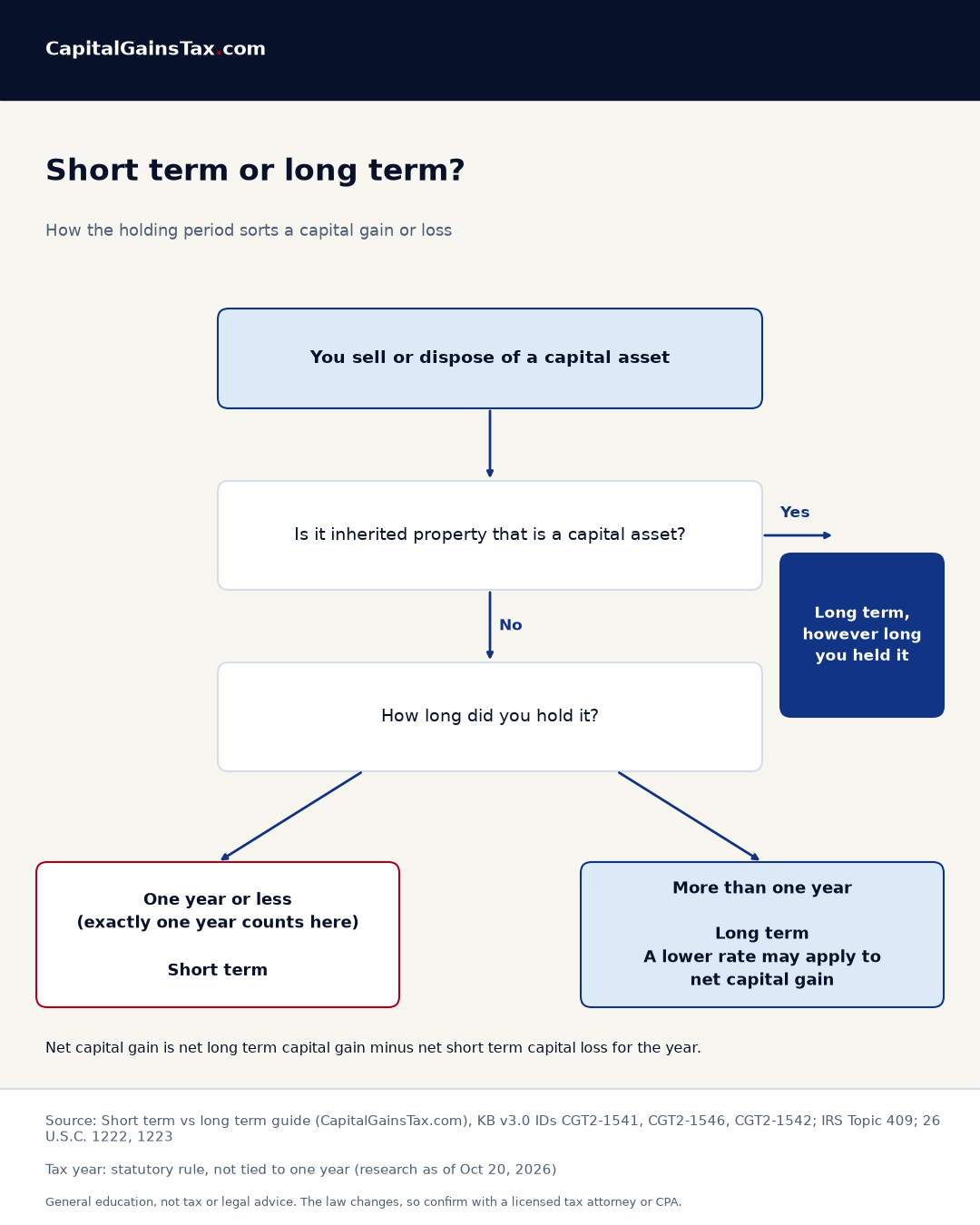
The general rule for your holding period
You generally classify your capital gain or loss by how long you held the asset before disposing of it. Your short term category generally covers both profits and losses from assets owned for no more than twelve months. Disposal after an ownership period exceeding one year generally gives you long term treatment for either outcome, a profit or a loss. You use these classifications to determine your net capital gain or loss.
The distinction at one year matters. Under the general rule, you need more than one year for long term treatment. Holding your asset for exactly one year falls within the short term category. The same general boundary applies when you have a capital loss rather than a capital gain.
For the statutory definition of short term capital gain, you must have gain from selling or exchanging a capital asset held for not more than one year. That definition applies if, and to the extent that, you include the gain in computing gross income.
Why your classification affects the tax calculation
You first classify your gains and losses as ordinary or capital. You next separate the capital category into its two holding period groups, short term and long term. These are separate classifications in the process described by the IRS.
Your ordinary income rate may exceed the rate applicable to your net capital gain. Your net capital gain is the amount by which your net long term capital gain for the taxable year exceeds your net short term capital loss for that year.
Your net short term capital loss therefore forms part of the definition of net capital gain. You compare it with your net long term capital gain for the same taxable year. You may qualify for a rate below your ordinary income rate on the excess remaining after that comparison.
If you have long term gains and losses, you must also identify your 28% rate gains and losses. If you have a net capital gain, you must identify any unrecaptured section 1250 gain. Your short term or long term classification is one part of these required classifications.
Inherited capital assets receive special treatment
If you sell or dispose of inherited property that is a capital asset, your gain or loss is considered long term regardless of how long you held the property. This rule covers both your gain and your loss. It specifically applies to inherited property that is a capital asset.
Section 1223 also provides a rule when you acquire property from a deceased person, or it passes to you from that person, within the meaning of section 1014(b). If your basis is determined under section 1014 and you sell or otherwise dispose of the property within one year after that person's death, you are considered to have held it for more than one year.
Your holding period can include a previous owner's period
Your holding period can include the period another person held the property. Under section 1223, this applies when your basis for determining gain or loss from a sale or exchange is wholly or partly the same as the basis the property would have in that person's hands under the relevant tax provisions.
The rule applies however you acquired the property, provided you meet that basis condition. You count the previous owner's time if the relevant tax provisions preserve all or part of that owner's basis in your calculation of profit or loss upon selling or exchanging the asset.
When you receive a gift, you are generally allowed to add the donor's holding period to your own. That combined period can qualify your gain as long term when you sell. The general rule for including another person's period depends on the relationship between your basis and that person's basis.
Property received in an exchange
Your holding period for property received in an exchange includes your holding period for the property you exchanged if you meet the statutory conditions. You must retain all or part of the surrendered asset's basis under the relevant tax provisions when calculating profit or loss from selling or exchanging the replacement.
You must also meet a condition concerning the property you exchanged. At the time of the exchange, that property must have been a capital asset under section 1221 or property described in section 1231. Both the basis condition and the condition concerning the exchanged property belong to this holding period rule.
For this rule, your involuntary conversion described in section 1033 is treated as an exchange of the converted property for the acquired property. A distribution to you covered by section 355, or by the portion of section 356 relating to section 355, is also treated as an exchange.
Partnership property and applicable partnership interests
If a partnership distributes property to you, your holding period includes the period the partnership held that property. You count a contributing partner's ownership time too, where the partnership received the distributed asset from that partner.
For your distributed property, the included periods can therefore reach back through the partnership to a contributing partner. The contributing partner's period is included when that partner contributed the property to the partnership.
Beginning in 2018, you need a holding period of more than three years for long term treatment of certain gains relating to applicable partnership interests. If your gain is among those covered gains, the usual more than one year boundary is replaced by the more than three years requirement.
Average basis and the holding period for your shares
When you figure average basis, you include all unsold shares of identical stock in an account. Even with that average basis calculation, selling your shares may produce both short term and long term gains or losses.
To determine your holding period in this setting, the shares you dispose of are considered to be those you acquired first. Your use of average basis still leaves a separate holding period determination for the shares sold.
Your holding period when you close a short sale
When you close a short sale, you determine whether the resulting gain or loss is short term or long term from the acquisition date of the security you deliver to close it, but your gain is short term if you held substantially identical property for one year or less on the short sale date or acquired substantially identical property after the short sale but on or before its closing date. You must apply section 1233(d) if it applies.
Your holding period for an installment sale
For your installment transaction, ownership exceeding twelve months at the sale establishes long term gain. If your gain qualifies for long term capital gain treatment in the year of sale, it continues to qualify in later tax years.
For this rule, you look to your ownership period when you sold the property. The installment sale rules discussed apply to Schedule D for Forms 1040, 1041, 1065, 1120 and 1120 S.
Stock distributions can create a capital gain
If you receive a nondividend distribution from an S corporation, it is tax free to the extent it does not exceed your stock basis, debt basis does not count in determining its taxability, and any excess is taxed as a capital gain on your personal return. Your excess distribution receives long term classification when ownership of the S corporation shares exceeds twelve months.
Once you have adjusted your stock basis to zero, you report any additional returns or distributions, other than dividend distributions, on Schedule D for Form 1040 and Form 8949. You report gains from stock held longer than one year as long term capital gains.
Your holding period determines the long term classification described in these rules. The distribution rules also retain their basis conditions and their distinction between dividend and nondividend distributions.
Your 28% rate gain has a separate definition
For the relevant tax rate subsection, your 28% rate gain means the excess, if any, of your collectibles gain plus section 1202 gain over a specified group of losses. Those losses are your collectibles loss, your net short term capital loss and your long term capital loss carried to the taxable year under section 1212(b)(1)(B).
You must distinguish the 28% rate category within your long term profits and losses. You must separately determine whether your net capital gain contains an unrecaptured section 1250 amount.
Illustrative example of the one year boundary
Illustrative example: You sell a capital asset after holding it for exactly one year. Under the general holding period rule, your capital gain or loss is short term because your holding period is one year or less. Your alternative illustrative outcome after two years of ownership generally belongs in the long term category, whether the sale produces a profit or a loss. Your inherited capital asset receives that same classification on disposal even with a shorter ownership period, whether you realize a profit or a loss.
From Richard C. Wilson
Are You Prioritizing Tax Strategies or Tax Advantages?
Questions
Does holding your asset for exactly one year qualify you for long term treatment?
Does your inherited property need a full year of ownership?
Can you include the donor's holding period for a gift?
Does your installment sale gain keep its long term classification?
Does every long term holding period use the one year boundary?
Sources
- Topic no. 409, Capital gains and losses
- 26 U.S. Code Section 1223, Holding period of property
- Publication 550 (2025), Investment Income and Expenses
- 26 U.S. Code Section 1222, Other terms relating to capital gains and losses
- CGT on gift of property: Capital gains tax on gifted property explained for US expats (2026)
- Publication 541, Partnerships
- Instructions for Schedule D (Form 1040) (2025)
- Instructions for Form 1099-B (2026)
- Publication 537, Installment Sales
- S corporation stock and debt basis
- Mutual funds (costs, distributions, etc.)
- 26 U.S. Code Section 1, Tax imposed